Unlimited Throws: What If the Carnival Game Was Free?
How cooperative business simulation addresses entrepreneurial access inequality
Jonathan R. Jones Founder & General Manager, Liana Banyan Corporation
A growing body of research confirms what practitioners have long observed: entrepreneurial success correlates more strongly with access to capital and tolerance for repeated failure than with talent, education, or effort. Studies from the Kauffman Foundation, the Global Entrepreneurship Monitor, and Hurst and Lusardi’s work on household wealth and business formation consistently show that the single best predictor of who starts a business is not skill but financial cushion — the ability to absorb losses and try again. This paper proposes a structural intervention: a cooperative business simulation model that decouples entrepreneurial practice from financial risk, enabling iterative failure at near-zero cost within a shared-knowledge ecosystem. The model is operational and its mechanics are drawn from nine years of development, 1,200+ documented innovations — 99% utility patents, not design — protected by 210 formal claims across 7 applications (eight definite with 9 more out of the first 130 so far have survived a deep dive against the U.S. patent office with no prior art found), and the author’s own documented experience with high-volume iterative failure in competitive domains.
In November 2017, a user on Hacker News articulated the access problem with unusual clarity:
“Entrepreneurship is like one of those carnival games where you throw darts. Middle class kids can afford one throw. Most miss. Rich kids can afford many throws. They try over and over until they hit something, then give speeches about meritocracy. Poor kids aren’t visiting the carnival. They’re the ones working it.”
That resonated with me, because my favorite part of all the “How to Make Money” books is usually in the first few pages, where it starts with “Take your disposable income, and…”
Wait, what? Which part of my income — which fields are eaten long before harvest — is disposable?
The thread that followed drew hundreds of responses from engineers, founders, and frustrated builders, all wrestling with the same question: Why isn’t life fair? The consensus answer: it just isn’t. Different starting lines. Different means. The universe doesn’t care.
They’re right. Life isn’t fair.
But that’s a description, not a design. And design is the part we can change.
The structural problem: iteration cost as barrier to entry
The HN commenter identified a structural issue that entrepreneurship literature has quantified but not solved: wealthy founders get unlimited iterations.
The game itself — starting a business, testing an idea, iterating on a product — isn’t actually that hard to learn if you can survive the learning. The hard part is funding the misses. Every failed startup costs money. Every pivot costs time. Every “learning experience” shows up as rent due, kids to feed, and that quiet erosion of confidence when people around you start suggesting you get a “real job.”
The dart game isn’t rigged because the target is impossible. It’s rigged because the price of each throw eliminates most players before they ever develop the arm.
Developers sometimes hack around this by moonlighting: day job for cash, nights and weekends for side projects. That’s a real advantage in software. But what about the meal-prep entrepreneur? The neighborhood mechanic? The woman who could run logistics for an entire community if someone would just let her prove it?
For them, every throw costs real money in a real world that doesn’t care about their potential.
Jim Carrey has a line in Dumb and Dumber that captures the emotional dimension of this access gap with disarming precision: “Don’t you just get tired of eking by?” That ache — the one that makes you look at the carnival game and think I could hit that target if they’d just let me throw — is not laziness. It’s not entitlement. It’s the rational frustration of a capable person staring at a system that charges admission for the privilege of trying.
The intervention I propose addresses this directly: eliminate the iteration cost.
The model: cooperative business simulation at near-zero cost
The proposed solution is not a curriculum, a course, or a case-study library. It is a live simulation environment embedded within a cooperative commerce platform, where participants practice real business operations with real teams against real market logic — but where failure carries educational consequences rather than existential ones.
It’s free once per day. Or, if you get the $5 annual membership, it’s unlimited every day — five dollars for unlimited throws at the carnival game.
The HexIsle Business Simulator is this environment, built inside a cooperative commerce platform called Liana Banyan. Its mechanics are wired to real economic logic: participants assemble a crew, run a business, and make decisions that have real consequences for their crew and their future venture — but the consequences are educational, not existential.
HexIsle is an actual, real-world, utility-patented, water-powered physical-computing product line, structured as an island-building game with seven islands — HARVEST, NAVIGATE, ENGINEER, BATTLE, SEEK, INVOKE, and TRAIN. The seventh island, TRAIN, is where crews practice running actual businesses together — honing skills and developing teams that can later generate real revenue when they step out of the simulator and into the marketplace. The product lines from HexIsle, and the patents behind them, are given to participants as seeds for their own business.
The simulation doesn’t punish failure. It requires it. Every failed attempt surfaces what doesn’t work so participants can find what does. As Warren Buffett observed, good decisions come from experience, and experience comes from bad decisions; HexIsle is where you can compress a lifetime of those decisions into practice instead of ruin.
This model differs from conventional incubators and accelerators in three structural ways. First, it is cooperative — participants own the platform they practice on, and the margin is constitutionally fixed at 20%, preventing the extractive drift that characterizes most platform economies. Second, it is iterative by design — the $5 annual cost enables unlimited attempts, removing the financial penalty that normally accompanies entrepreneurial experimentation. Third, it is communal — lessons from failure are documented, shared, and accumulated across the ecosystem rather than dying with each individual venture.
Case evidence: the value of high-volume iterative failure
The philosophical foundation of this model — that losing is not merely tolerable but actively beneficial — is illustrated by two reference points from the author’s experience.
Competitive chess as a persistence laboratory
On a single account, I’ve played more than 25,000 games of online chess. My peak rating hit around 2118 — roughly the top half-percent of players worldwide. On most days I hover in the 2080s.
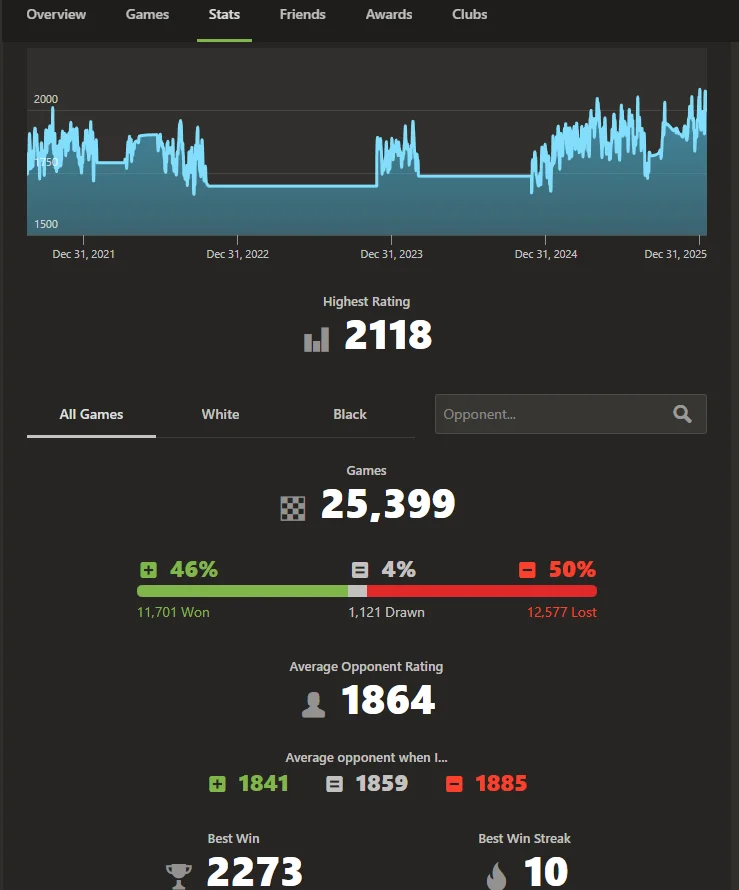 Chess.com statistics — verified January 2026
Here’s the important part: I’ve lost more games than I’ve won.
About half my games are losses. My win rate is under 50%. The rest are draws. I live in the top tier of a brutally efficient ranking system, and I lose as much as I win.
How? Because every loss taught me something. As you improve, you just face stronger opposition. The losses get harder, which means the education gets deeper.
If you flip a fair coin 100 times, you’ll see roughly 50 heads and 50 tails. Over enough throws, wins and losses even out. The edge doesn’t come from never losing. It comes from how you treat each loss — as shame, or as tuition.
The only way to get ahead when you lose half the time is to play a different game: learn from every loss, bank the lessons, and keep throwing.
Calvin Coolidge was right: persistence alone is omnipotent.
The chess data demonstrates a principle directly applicable to entrepreneurial simulation: elite performance is compatible with — even dependent on — a high failure rate, provided that failures occur within a system that enables rapid iteration and progressive learning. The ELO rating system, like a well-designed business simulator, doesn’t punish you for losing. It matches you against increasingly capable opponents, ensuring that your losses become more instructive over time.
The “Megamind principle” in simulation design
The animated film Megamind (2010) contains two lines that articulate the design philosophy of the HexIsle simulator with surprising precision.
Megamind himself: “There’s a benefit to losing: you get to learn from your mistakes.”
Roxanne Ritchi, about him: “The Megamind I knew would never have run from a fight, even when he knew he had absolutely no chance of winning. It was your best quality.”
The first line is a statement about feedback loops: failure produces learning if — and only if — the system is designed to surface the lesson. Traditional entrepreneurship buries the lesson under financial ruin. A simulation surfaces it for free.
The second line is a statement about selection effects: the people who persist through impossible odds are the ones who eventually break through. But in the current system, persistence is a luxury good — you can only keep fighting if you can afford to keep losing. The cooperative simulation model democratizes that persistence by removing the cost floor.
Knowledge accumulation: from private loss to public infrastructure
The rules of how to defuse bombs are written in blood; but there are only so many rules to learn. A brutally effective strategy — especially when the path is shared.
Every entrepreneur who fails learns something. The problem is that most of them learn it alone, at enormous personal cost, and the lesson dies with their business. The knowledge written in their blood evaporates.
This is the critical structural difference between a venture-capital ecosystem and a cooperative one. In the VC model, failure is private. Postmortems, when they exist, circulate as anecdotes. Lessons are absorbed by individuals, not systems. The next founder approaching the same problem starts from scratch.
In a cooperative simulation model, failure is communal. Lessons are documented, shared, and accumulated across the ecosystem. Each crew that fails inside HexIsle leaves behind a trail — a permanent record of what didn’t work and why — that the next crew can study before they attempt the same terrain.
So as I carve a pathway to success, I feel an obligation to cut a permanent trail through the jungle for anyone who dares to follow, charting the pitfalls, dead-ends, failures, open mineshafts, and resources on my treasure map.
I don’t know exactly which paths I’ll take. But I know what I’m building toward: a world where the cost of trying is low enough that persistence really can be omnipotent.
Conclusion: the free carnival is already built
The 2017 Hacker News thread arrived at a collective resignation. Life isn’t fair. Wealth concentrates. The carnival game is what it is. A few commenters pushed back — “the whole point of human culture is to transcend the raw reality the universe hands us” — but emotionally, the conclusion was a shrug.
Here’s what they missed: the free carnival is already built, and it’s growing.
Liana Banyan is a cooperative commerce platform with sixteen charitable initiatives, a fixed 20% margin locked by operating agreement, and a business simulator that lets anyone — poor kids, rich kids, immigrant kids, kids who’ve been working the carnival their whole lives — practice entrepreneurship at near-zero risk.
We didn’t wait for life to become fair. We built a corner of it that’s fair enough to start.
The annual membership is five dollars. The daily throw is free. The lessons are shared. The crews are real. The businesses you practice with become the businesses you launch.
And together, we can add up all our collective mistakes and throw time after time after time. Until we win.
A note on participation
Megamind never ran from a fight, even when he knew he had absolutely no chance of winning.
Neither do we — and we’re busy making our own chances.
If you’re the kind of person who wants more throws at the dartboard — and you’re willing to share what you learn when you miss — the door is open.
LianaBanyan.com · the2ndsecond.com
Help each other help ourselves.
Jonathan R. Jones is the founder and general manager of Liana Banyan Corporation, a cooperative commerce platform operating on a Cost + 20% model with sixteen permanently funded charitable initiatives. He is a U.S. ARNG veteran (Infantry 11B, Aviation 15A), FAA Commercial Rotary Wing IFR-rated helicopter pilot, father of eight, and holds a chess rating in the top half-percent worldwide. He has been developing cooperative economics concepts for 42 years and actively building the Liana Banyan platform for nine. His patent portfolio includes 1,200+ documented innovations, prototypes over 23 years, with 8 definite utility patents (9 more possible) across six applications.