Unlimited Throws: What If the Carnival Game Was Free?
Jonathan R. Jones Founder & General Manager, Liana Banyan Corporation
In November 2017, a user on Hacker News wrote:
“Entrepreneurship is like one of those carnival games where you throw darts. Middle class kids can afford one throw. Most miss. Rich kids can afford many throws. They try over and over until they hit something, then give speeches about meritocracy. Poor kids aren’t visiting the carnival. They’re the ones working it.”
That resonated with me, because my favorite part of all the “How to Make Money” books is usually in the first few pages, where it starts with “Take your disposable income, and…”
Wait, what? Which part of my income — which fields are eaten long before harvest — is disposable?
The thread that followed was extraordinary. Hundreds of engineers, founders, and frustrated builders wrestling with the same question: Why isn’t life fair? The consensus answer: it just isn’t. Different starting lines. Different means. The universe doesn’t care.
They’re right. Life isn’t fair.
But that’s a description, not a design. And design is the part we can change.
The Problem Isn’t the Dart. It’s the Price of Throwing.
The HN commenter nailed the structural issue: rich kids get unlimited throws.
The game itself — starting a business, testing an idea, iterating on a product — isn’t actually that hard to learn if you can survive the learning. Every failed startup costs money. Every pivot costs time. Every “learning experience” shows up as rent due. There are kids to feed. There’s the quiet erosion of confidence when people around you start suggesting you get a “real job.”
The dart game isn’t rigged because the target is impossible. It’s rigged because the price of each throw eliminates most players before they ever develop the arm.
Developers sometimes hack around this by moonlighting: day job for cash, nights and weekends for side projects. That’s a real advantage in software. But what about the meal-prep entrepreneur? The neighborhood mechanic? The woman who could run logistics for an entire community if someone would just let her prove it?
For them, every throw costs real money in a real world that doesn’t care about their potential.
Jim Carrey has a line in Dumb and Dumber that I feel in my bones every single day: “Don’t you just get tired of eking by?”
That ache — the one that makes you look at the carnival game and think I could hit that target if they’d just let me throw — is not laziness. It’s not entitlement. It’s the rational frustration of a capable person staring at a system that charges admission for the privilege of trying.
So I built something for them. For us.
What If We Made the Dart Game Free?
I built a business simulator. Not a spreadsheet. Not a case study. Not a course where you read about entrepreneurship from someone funded by their parents’ friends.
I built a place where you can throw darts all day long and never go broke.
It’s free once per day. Or, if you get the $5 annual membership, it’s unlimited every day — five dollars for unlimited throws at the carnival game. If you have a business in your head or half-built in your spare time, but the cost of “one more try” feels unbearable, HexIsle is for you.
The HexIsle Business Simulator
The HexIsle Business Simulator is a real-world training environment embedded inside a cooperative commerce platform called Liana Banyan. It’s a game whose mechanics are wired to real economic logic: you assemble a crew, you run a business, and you make decisions that have real consequences for your crew and your future venture — but the consequences are educational, not existential.
HexIsle is an actual, real-world, utility-patented, water-powered physical-computing product line, disguised as an island-building game with seven islands:
- HARVEST — Resource acquisition
- NAVIGATE — Strategic direction
- ENGINEER — System design
- BATTLE — Competition and defense
- SEEK — Opportunity discovery
- INVOKE — Team and resource activation
- TRAIN — Business practice
The seventh island, TRAIN, is where crews practice running actual businesses together — honing skills and developing teams that can later make real money together when they step out of the simulator and into the marketplace. The product lines from HexIsle, and the patents behind them, are given to you as seeds for your own business.
Real business will always carry risk; no platform can erase that. But HexIsle shifts a huge share of the learning cost out of your rent and savings and into a bounded simulation, where the crew you win with in practice becomes the crew you go to market with, using the same skills and habits you developed together.
The simulation doesn’t punish you for failing. It lets you try anything and everything — “fail fast, fail often,” as Silicon Valley likes to say — because every failed attempt shows you what doesn’t work so you can find what does. As Warren Buffett put it, good decisions come from experience, and experience comes from bad decisions; HexIsle is where you can compress a lifetime of those decisions into practice instead of ruin.
The Benefits of Losing
One of my favorite animated films is Megamind. Not for the animation or the jokes, but for two lines I’ve carried for years.
Megamind himself: “There’s a benefit to losing: you get to learn from your mistakes.”
Roxanne Ritchi, about him: “The Megamind I knew would never have run from a fight, even when he knew he had absolutely no chance of winning. It was your best quality.”
That’s the philosophy of HexIsle, and of Liana Banyan.
The benefit of losing is learning. And the willingness to fight — even hopelessly, even when the odds are absurd — is not foolishness. It’s the quality that separates the people who eventually win from the people who never throw.
I know this because I’ve lived it in the most quantifiable arena on earth.
25,399 Games
On a single account, I’ve played more than 25,000 games of online chess. My peak rating hit around 2118 — roughly the top half-percent of players worldwide. On most days I hover in the 2080s.
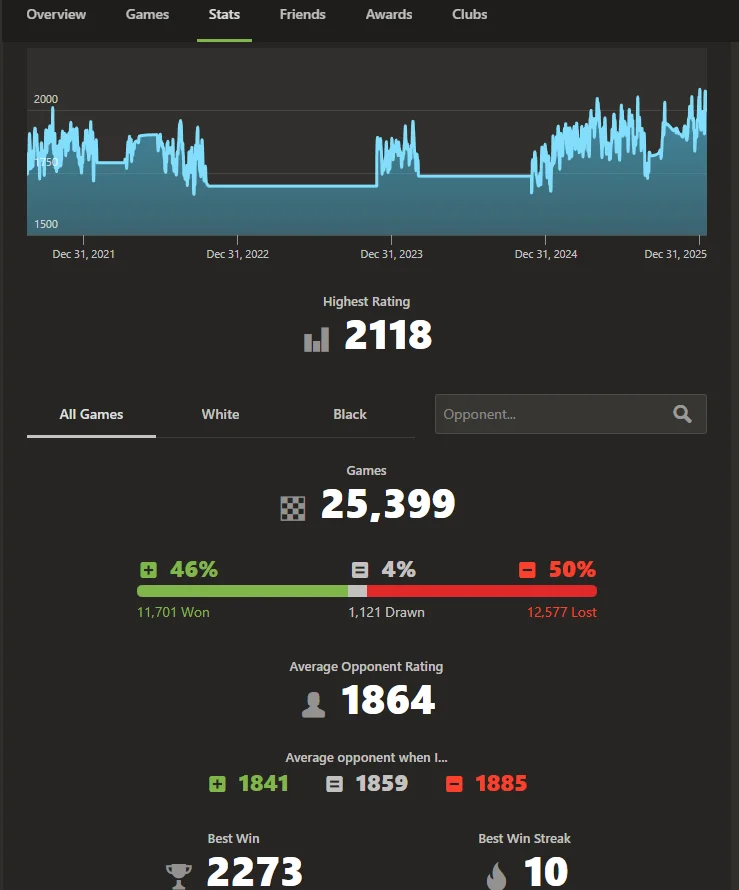 Chess.com statistics — verified January 2026
Here’s the important part: I’ve lost more games than I’ve won.
About half my games are losses. My win rate is under 50%. The rest are draws. I live in the top tier of a brutally efficient ranking system, and I lose as much as I win.
How? Because every loss taught me something. As you improve, you just face stronger opposition. The losses get harder, which means the education gets deeper.
If you flip a fair coin 100 times, you’ll see roughly 50 heads and 50 tails. Over enough throws, wins and losses even out. The edge doesn’t come from never losing. It comes from how you treat each loss — as shame, or as tuition.
The only way to get ahead when you lose half the time is to play a different game: learn from every loss, bank the lessons, and keep throwing.
Calvin Coolidge was right: persistence alone is omnipotent — once the cost of trying is low enough.
Bomb Rules Written in Blood
The rules of how to defuse bombs are written in blood; but there are only so many rules to learn. A brutally effective strategy — especially when the path is shared.
Every entrepreneur who fails learns something. The problem is that most of them learn it alone, at enormous personal cost, and the lesson dies with their business. The knowledge written in their blood evaporates.
So as I carve a pathway to success, I feel an obligation to cut a permanent trail through the jungle for anyone who dares to follow, charting the pitfalls, dead-ends, failures, open mineshafts, and resources on my treasure map.
I don’t know exactly which paths I’ll take. But I know what I’m building toward: a world where the cost of trying is low enough that persistence really can be omnipotent — and where no effort is wasted, only misapplied until it finds the right path.
What the HN Thread Got Wrong
The 2017 Hacker News thread arrived at a collective resignation. Life isn’t fair. Wealth concentrates. The carnival game is what it is. A few commenters pushed back — “the whole point of human culture is to transcend the raw reality the universe hands us” — but emotionally, the conclusion was a shrug.
Here’s what they missed: the free carnival is already built, and it’s growing.
Liana Banyan is a cooperative commerce platform with sixteen charitable initiatives, a fixed 20% margin locked by operating agreement, and a business simulator that lets anyone — poor kids, rich kids, immigrant kids, kids who’ve been working the carnival their whole lives — practice entrepreneurship at near-zero risk.
We didn’t wait for life to become fair. We built a corner of it that’s fair enough to start.
The annual membership is five dollars. The daily throw is free. The lessons are shared. The crews are real. The businesses you practice with become the businesses you launch.
Play HexIsle, learn the system with your crew, then launch on the marketplace using the same people and skills you proved in the simulator.
And together, we can add up all our collective mistakes and throw time after time after time. Until we win.
Join Us
Megamind never ran from a fight, even when he knew he had absolutely no chance of winning.
Neither do we — and we’re busy making our own chances.
If you’re the kind of person who wants more throws at the dartboard — and you’re willing to share what you learn when you miss — the door is open.
- Start by playing one free run of HexIsle
- Read “$5 Can Save the World” at the2ndsecond.com to see the cooperative math behind it
LianaBanyan.com · the2ndsecond.com
Help each other help ourselves.
For Academic Readers (SSIR Framing)
This essay proposes a cooperative simulation model as a structural intervention for entrepreneurial access inequality. The core mechanism — a free daily simulation combined with low-cost unlimited access — reduces the marginal cost of entrepreneurial learning to near-zero while maintaining authentic business decision-making through a bounded consequence framework.
The model connects to existing literature on:
- Failure-tolerant design (Edmondson, 2011)
- Entrepreneurial equity (Fairlie & Robb, 2008)
- Cooperative economics (Ostrom, 1990)
The HexIsle system represents a specific implementation of these principles within a broader cooperative commerce infrastructure designed for sustained universal economic participation.
Originally published on Medium. Adapted version submitted to Stanford Social Innovation Review.
FOR THE KEEP.
🏰⚔️